Activating Outdoor Learning Spaces at Wandana Primary School
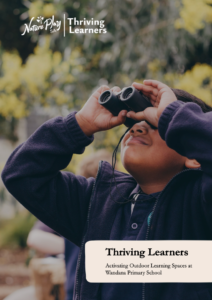 For this Thriving Learners project, staff at Wandana Primary School sought to explore all four Areas of Impact (wellbeing, student agency, effective learners, equity and excellence) by activating an outdoor learning space to build children’s connection to place and nature. Educators also aimed to enhance their knowledge and confidence in outdoor learning while creating more diverse play opportunities for all learners.
Read about how this partnership effectively brought the Areas of Impact to life by creating a rich, student-centred learning environment that prioritised agency, connection to place, and deep engagement with nature. Through nature-based experiences, the program ensured that all students, regardless of background or ability, could engage meaningfully with their environment.
Activating Outdoor Learning Spaces at Wandana Primary SchoolPlanning your own nature-based project
A helpful collection of resources and research to support your nature play and outdoor learning project.
Why Sheets: The Benefits of Nature Play
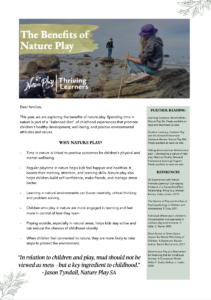 These Why Sheets, inspired by the work of Alfie Kohn, are research-supported documents designed for educators to share with families about the importance and benefits of nature play. We understand how busy educators are, so these information sheets have been created to help them easily communicate the value of nature play and outdoor learning.
The Why Sheets can be downloaded to support:
Sensory Play Resources
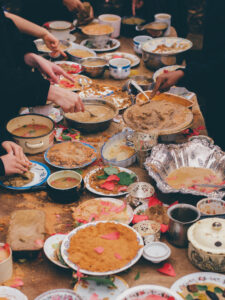
Sensory play is important for children’s health, development and wellbeing. Mud play allows children to explore and create freely, building critical thinking, fine motor skills, and sensory awareness, while fostering creativity and problem-solving.
Learning Outdoors: Benefits and Risks
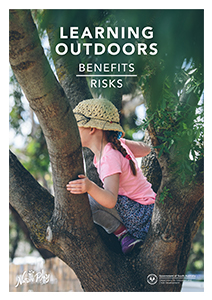 The nature-based outdoor learning environment offers a unique opportunity for educators to encourage the stretching process in children and help them realise their full potential. When outdoor learning environments are places that allow inspiration and creativity to take root, for curiosity and spontaneity to be realised and importantly, for risk and failures to be viewed as positive learning experiences, children will be the beneficiaries. This learning can help them develop the life skills and awareness they need to be confident, resilient and able-bodied adults who take responsibility for themselves and their actions.
Outdoor Learning Framework
This framework will help you establish routines, boundaries and expectations in a fun and simple way.
Outdoor Lesson Framework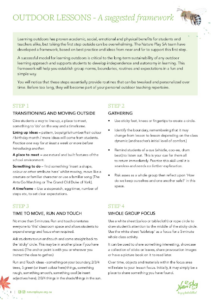
'Detective' ID Sheets
 Green Adelaide offer a range of resources for teachers, information on gardens, samphires, native grass and more.
The case for taking learning outside
A quick guide to key research that helps make the case for nature-based learning in your classroom, school or site.
Play promotes mental health
Gray, P. (2011). The decline of play and the rise of psychopathology in children and adolescents. American Journal of Play, 3(4), 443–463.
Exposure to nature is associated with improved cognitive function, mental health, physical activity, and other health benefits
Jimenez, M. P., DeVille, N. V., Elliott, E. G., Schiff, J. E., Wilt, G. E., Hart, J. E., & James, P. (2021). Associations between nature exposure and health: A review of the evidence. International Journal of Environmental Research and Public Health, 18(9), 4790.
This narrative review summarises recent experimental and observational studies on the associations between nature exposure and health outcomes, finding evidence for improved cognitive function, mental health, physical activity, and sleep, with protective effects on mental health and cognitive function from experimental studies and positive associations with physical activity and reduced cardiovascular disease risk from observational studies.
Engagement in natural environments fosters children's physical, social, and cognitive growth
Elliot, S. & Chancellor, B. (2014). From forest preschool to Bush Kinder: An inspirational approach to preschool provision in Australia. Australasian Journal of Early Childhood, 39(4), 45-53.
The study From Forest Preschool to Bush Kinder: An Inspirational Approach to Preschool Provision in Australia by Sue Elliott and Barbara Chancellor explores the implementation of the Bush Kinder program at Westgarth Kindergarten, inspired by European forest preschools. As part of Australia’s universal access initiative, the program integrates outdoor, play-based learning in local parklands alongside traditional preschool education. Findings highlight the benefits of Bush Kinder, including increased physical activity, improved social and emotional development, and stronger connections to nature and community. The study underscores how outdoor education fosters child-led learning, engagement, and wellbeing, offering a compelling alternative to conventional preschool settings.
Child-led outdoor play fosters creativity, problem-solving, and care for nature.
Davis, J. (2014). What is early childhood education for sustainability? In E. Davis (Ed.), Young Children and the Environment: Early Education for Sustainability (pp.24-42). Cambridge University Press.
This groundbreaking textbook on early childhood education for sustainability addresses the critical issue of environmental change and highlights the role of early education in fostering sustainable living. Designed for early childhood teacher education students, childcare practitioners, and primary school teachers, it promotes sustainability education from birth to eight years. The text connects with global initiatives such as Sustainable Schools, Child Friendly Cities, and Health Promoting Schools, exploring their relevance to early learning. Drawing on recent literature, it examines organisational, educational, and cultural change, ethical challenges, and the role of ICT in advancing sustainability education. Case studies, vignettes, and thought-provoking prompts encourage innovative thinking about children’s engagement with the environment and the transformative potential of early education.
Stories and Ideas to Support Your Journey
Articles and examples of practice from around South Australia to inspire and support your nature play and outdoor learning journey.
Play and the brain: how neuroscience can be used in the fight for more play in education
 Play is the language of the child; it is how they make sense of and learn about their world. As Play researcher Dr Stuart Brown says, “We are built to play, and built through play” (1). As a qualified Play Therapist, Early Childhood Teacher and Nature Play Educator, I’m a passionate advocate for play and its applications for use in the classroom and beyond. Play is fun, motivating, and intrinsic to the lives of children. And it is through the experiences of play that brains best develop. But sadly, once children leave early childhood settings, play often takes a backseat.
Elevating Educator Voices: Tumby Bay Kindergarten
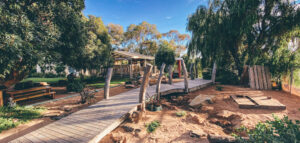
Tumby Bay Kindergarten is a magnificent example of what can be achieved when educators embrace their space and context. Over time, the knowledge, skills and passion of these educators have created a unique and magical space for children to grow and flourish.
Elevating Educator Voices: Tumby Bay KindergartenMental Health and the Calming Refrain of Nature
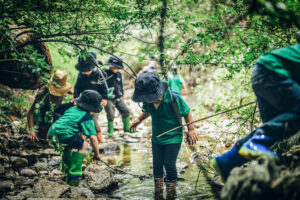 The rise in mental health statistics in Australia, for both adults and children, is alarming and indicates a need for greater intervention across all facets of our lives. Strategies to approach mental health and wellbeing vary greatly; however, extensive research is emerging that demonstrates spending time in nature improves the mental health of children and adults. In this practical piece Nature Play SA’s General Manager Jason Tyndall provides some practical ideas to encourage children to spend more time in nature within an education context.
Watch Your Words - Intentional Teaching Through our Language
The way we talk to children can influence the 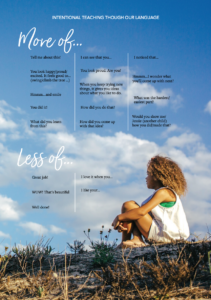 perceptions they form of themselves – but do we really have a firm grasp on the importance of language and how we should be talking with our children? In this article, Lisa Burman highlights the need to consider our language and intentional teaching when communicating with children as it has a profound ability to empower strong, self-directed, resilient learners.
The Language of Birds - Exploring the "Hundred Languages" of children
Learners at Tanunda Lutheran ELC made their learning about birds visible through some of the “Hundred Languages” of children – conversations, dance, songs, yoga, photography, paintings, drawings, clay, storytelling, videos, collage, mosaics, wood constructions – and the list goes on. Each language allowed the children to explore and express their thoughts and observations in different ways.
The Language of BirdsDocumenting Growth and Connection
Tools to help make nature play and outdoor learning visible.
Practitioner Guide to Assessing Connection to Nature
How can you assess connection to nature? Researchers and evaluators have developed numerous tools to measure connections to nature, including surveys, observational strategies, and interview guides.
Practitioner Guide to Assessing Connection to NatureAreas of Impact: Observational Story
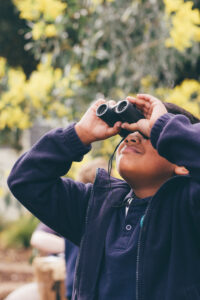 The Areas of Impact: Observational Story (Ob Story) aims to record how the Department for Education’s Areas of Impact (AOI) may be engaged in nature play settings. The AOI are four domains that support children to learn in holistic and supportive environments:
- Wellbeing
- Effective Learners
- Learner Agency
- Equity and Excellence
The Ob Story has been developed for use by Nature Play SA in their work with site schools and kindergartens. It is also designed for possible future use by teachers and educators, and teaching teams at kindergartens and primary schools. The tool invites education professionals to record an observation of nature play. The Ob Story asks for curriculum links, detailed observation, social play types, considers the child’s perspective, and encourages reflective practice from the observer. There are two versions of the Ob Story that align with the Australian frameworks and curriculums used in South Australian public education: The Australian Curriculum V.9, and the Early Years Learning Framework (EYLF) V2.0.
Areas of Impact: Observational Story for the Australian Curriculum Version 9
Areas of Impact: Observational Story for Early Years Learning Framework Version 2.0
Social play type:
Noting the type of play may reveal how certain types of social play within nature influence the AOI. Tick play types identified in the play observation.
- Solitary play: a child plays on their own, without interacting with others.
- Onlooker play: a child observes other children playing.
- Parallel play: children play side-by-side, without interacting with each other.
- Associative play: children play side-by-side, with interactions such as sharing resources and speaking to each other.
- Cooperative play: children engage in play together that has an agreed upon, or shared outcome.


